
By Editor
Ekiti State Governor, Mr Biodun Oyebanji, has reaffirmed his administration’s commitment to creating an enabling environment where businesses can start, grow and prosper, assuring investors and private sector operators of the government’s readiness to address challenges affecting business growth in the state.
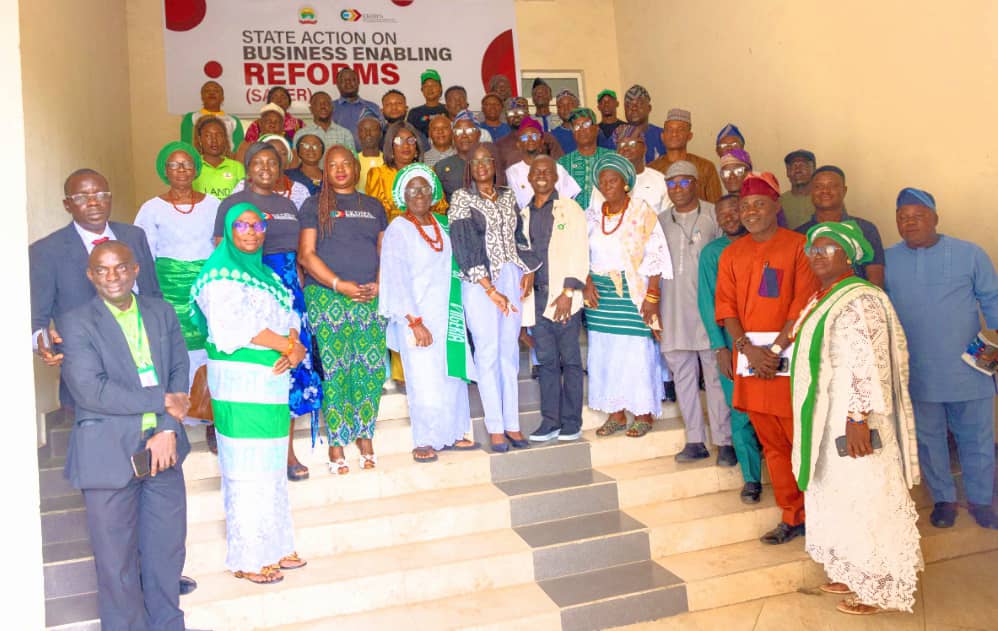
Oyebanji stated this on Thursday while speaking at the State Action on Business Enabling Reforms (SABER) Information Session and Investor Engagement Meeting, organised by the Ekiti State Development and Investment Promotion Agency (EKDIPA) at the Obafemi Awolowo Civic Centre, Ado-Ekiti.
The Governor, represented by the State Commissioner for Trade, Industry, Investment and Cooperatives, Mrs Omotayo Adeola, said government does not create jobs but provides the environment for the private sector to do so, stressing that the administration was committed to ensuring businesses in Ekiti could thrive.
He explained that SABER, a World Bank-supported programme incentivised by the Federal Government, was designed to help states improve their business environment through efficient land administration and transparent property transfer, an improved regulatory framework for private investment, investment promotion and aftercare, and transparency in government-to-business services.
The Governor said the state had embarked on deliberate reforms, including automating and reducing the time required to obtain Certificates of Occupancy and construction permits, harmonising taxes through the Ekiti State Internal Revenue Service (EKIRS), establishing Small Claims Courts for speedy resolution of commercial disputes, and digitising business premises registration.
Oyebanji stressed that reforms would only be meaningful when their impact was felt by end-users, urging participants to openly identify challenges affecting their businesses and provide feedback to help shape the state’s Action Plan for the next phase of reforms.
He added that the State Ease of Doing Business Council, which he chairs, had been constituted to ensure complaints received executive attention.
The Director-General of the Office of Transformation and Service Delivery (OTSD), Dr Moyo Ekundayo, said the engagement gave government and the private sector an opportunity to interact, share experiences and identify practical ways of improving the ease of doing business in Ekiti State.
He commended Oyebanji for carrying the people along in his administration and urged business owners to take advantage of government opportunities and available financial interventions, adding that Ekiti people should overcome their fear of borrowing, since productive borrowing could help businesses expand and contribute to economic development.
Earlier, in her welcome address, EKDIPA Director-General, Ms Ololade Olutola, said the objective was to ensure businesses in Ekiti did not merely exist but thrived, noting that the agency had been working with the Ministry of Trade, Industry, Investment and Cooperatives to implement reforms aimed at making the state more business-friendly.
She disclosed that the initial business registration fee had been waived for new business owners and urged entrepreneurs facing challenges to approach EKDIPA, which would link them with the relevant individuals, agencies and institutions to address such challenges.
The EKDIPA Boss described SABER as a mechanism for checking the health of the business environment — likening it to a blood pressure machine used in hospitals to identify areas requiring attention — and stressed the importance of feedback from businesses in improving the state’s business climate.
In his presentation, Ekiti State SABER Programme Manager, Mr Titus Adelusi, highlighted the Business Enabling Reform Action Plan (BERAP), access to markets, a centralised Grievance Redress Mechanism (GRM) and tax harmonisation among the reforms being pursued by the state.
He also noted the Small Claims Courts in Ado-Ekiti, Ikere-Ekiti and Ikole-Ekiti, which are mandated to determine eligible trade and commercial complaints within 60 days.
Speaking on access to finance, the Permanent Secretary, Ministry of Trade, Industry, Investment and Cooperatives, Pharm. Bunmi Ejimokun, said access to credit was critical to the growth of businesses, particularly Micro, Small and Medium Enterprises (MSMEs), noting that the government had introduced various interventions to ease access to funds.
She highlighted the N500 million Ekiti State Government Women Loan Initiative, which had benefited about 3,000 women; the N750 million EKSG/Bosak Micro-Lending Fund, which had reached about 8,000 beneficiaries; the N1 billion Cooperative Intervention Fund being developed for cooperative members; and the proposed N2 billion EKSG/Bank of Industry loan facility for industrialists, under which individual entrepreneurs could access up to N10 million.
Ejimokun said the state government remained committed to providing an enabling environment for business and industrial growth, adding that its participation in SABER was aimed at easing the ease of doing business and promoting shared prosperity in Ekiti State.
She urged entrepreneurs to approach the ministry to learn about and key into the available interventions.
The engagement brought together key government officials and private sector stakeholders, including the Centre Manager, Technology Incubation Centre, Mr Tola Fasan; Director-General, MEDA, Mr Kehinde Olatoye; Iyaloja Ekiti General, Chief (Alh.) Habibat Ogunjobi; and representatives of the Ministry of Finance, the National Association of Small and Medium Enterprises (NASME), the Ministry of Infrastructure and Public Utilities, the Ministry of Agriculture and Food Security, the Bureau of Statistics, EKIRS and the Bureau of Land Services and Signage.
Other participants included representatives of the Nigerian Association of Chambers of Commerce, Industry, Mines and Agriculture (NACCIMA), Ekiti State cooperatives, local palm oil producers, the All Farmers Association of Nigeria, cooperative farmers, the Chamber of Commerce, private sector development organisations, artisans and Iyalojas, among others.
The meeting provided a platform for stakeholders to engage government officials, raise concerns affecting their businesses, and contribute to ongoing efforts to strengthen Ekiti State’s business environment through practical and responsive reforms.
