
By Editor
Despite the declaration of a national emergency on food security in the country, the soaring prices of eggs and chicken in Nigerian markets has sparked concern among consumers and producers alike.
In the past two years, the prices of eggs and chicken have increased from 200 per cent to 250 per cent, depending on the parts of the country.
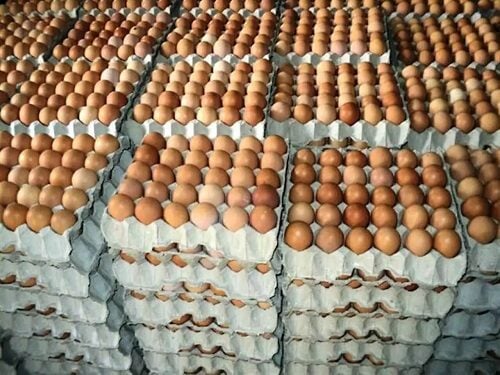
LEADERSHIP Friday checks in markets in various states of the federation showed that the prices of a crate of eggs jumped from N2,000 and N2,500 to N5,000 and N7,000 in just two years across the country. The same goes for the prices of chicken.
This development has forced most Nigerians, especially the poor, to stop including chicken and eggs in their menus, raising fears of protein deficiency among the citizens.
Two years ago, the government declared a state of emergency on food security, but the prices of most items have indeed gone up. Protein, the most essential need for a healthy society, does not seem to be within reach for many people because of high prices.
This year, specifically on 15th April 2025, President Bola Ahmed Tinubu again declared a national emergency on food security.
Protein is necessary for the body’s growth and development, maintenance, repair, and replacement of worn-out or damaged tissues, production of metabolic and digestive enzymes, and is an essential constituent of certain hormones. One primary source of protein for most households is eggs. However, a crate of eggs now sells for between N6,000 and N7,000, prompting consumers to cry out. In January 2023, one crate cost just N850, but by June 2023, following the general inflation that followed the removal of the petrol subsidy, the price had risen to between N2,000 and N2,200. Since then, the price has steadily increased to the present cost.
Middlemen to blame
A senior director in the Ministry of Livestock Development, who requested anonymity, attributed the sharp increase in egg and chicken prices to profiteering middlemen, fluctuating feed prices, and poor farm-level value addition.
Consumers in the states who spoke to LEADERSHIP Friday called for government intervention.
“Go to the market and ask the feed sellers. Six months ago, how much was a bag of feed? Today, how much is it? The same applies to eggs. You will see that farmers are not the ones making the big money. They are struggling with barely N200 profit per crate, while middlemen sometimes make as much as N500 per crate just by reselling,” the official told our correspondent.
According to him, poultry farmers face multiple challenges, ranging from unstable feed prices—especially maize-based feed—to high energy costs, poor water supply for birds, and low-quality inputs. These factors, he explained, reduce egg production capacity and shrink profit margins.
He added that feed prices have reduced by about 23 per cent, evidence that government policies have yielded visible results.
“If you go to the market, sellers will confirm feed prices are down, but is it reflected in the price of eggs and chicken? The answer is no. Why? Because middlemen have hijacked the process. If Dangote announces that fuel prices have dropped, does it reflect immediately? No, because marketers won’t allow it. But once he says the price has increased, everything goes up within minutes. That is the problem we face in this country,” he said.
Agricultural analyst Surajo Muhammad also commented that poor management practices, harsh weather, and high labour and administrative costs worsen farmers’ situations.
The ministry official and Muhammad recommended targeted government intervention through feed subsidies and direct support to poultry farms.
Similarly, Mr Erivona Philip, CEO of Rivona Farms, said the feed cost is not determined solely by the cost of raw materials but also by other factors, such as logistics/transportation and double taxation.
“The high cost of feed is not solely due to the high cost of raw materials. The cost of logistics/transportation, the problem of double taxation, and high operating costs all contribute to the high cost of poultry feed, so to achieve low-cost feed, the government must reduce these other costs.
“Farmers sell eggs between N5,000 and N5,500 per crate, depending on egg size and farm location. The harsh operating environment and the high cost of doing business are why retailers are selling between N5,600 and N7,000.”
Meanwhile, the CEO of Jekulla Int’l, Jeremiah Emmanuel Kucha, believes there is no reason for poultry feeds and other products to be as expensive as they are now. He argued that the cost of raw materials used in feed production has fallen significantly.
“There’s no reason for poultry feeds to be as expensive as they are now. People often blame the government for the high cost of goods and services, which is not always the case.
“Take, for instance, the poultry sector in Nigeria; there are more than a million and one reasons for prices of poultry products to have crashed drastically by now, but this has not happened yet. Instead, the prices of day-old chicks, which are the first step in production, are going up daily. People will blame the government, but is it actually the government making the prices higher? I don’t think so.
“Last year, the prices of poultry products skyrocketed due to a rise in the prices of the raw materials used in feed production. It will shock you to learn that this increase didn’t happen naturally but due to human insatiable greed.
“People with these raw materials hoard the goods, creating artificial scarcity that makes Nigerians pay through the nose to access them.
“This year, the story is different. The raw materials are available and accessible. Note that feed is the backbone of poultry, and it is a major determinant of the prices of poultry products. Its prices should have crashed by now. The major raw material used in its production—maize—has dropped by more than 60 per cent.
“Maize constitutes between 48–70 per cent of the raw materials used in poultry feed production. Last year, it was sold per bag for about N90,000 to N110,000. Today, the price is between N28,000 and N38,000 per bag, depending on where and how much you’re buying. This is a significant drop.
“The price of soya, the second primary raw material, has also reduced significantly. Our exchange rate has relatively improved, which should also reflect in the feed prices, as some micro-ingredients used in these feeds are sourced internationally.
“However, it is appalling that companies processing these feeds put the economy before society and humanity. They think more about making profits than making life easier for their customers.
“Despite the significant drop in the prices of raw materials used in feed production, some companies have only reviewed their prices downwards by about 9–10 per cent, which is too low and unsuitable for the sector.
“Hatcheries, for example, see August to November as the season to make more profit. I’m not against them making the best of the season, but it is challenging to do so without considering their customers.
“For example, in July 2025, broiler day-old chicks (DOCs) sold for between N400 and N550, and in less than two months, the same DOCs are being sold for between N1,600 and N1,850. That’s a rise of N1,200–N1,400. Did this happen because of a change in production costs? No! They see this period as a time to cash out on gullible customers, and that’s too much.
“I want to use this medium to call on hatchery owners and major stakeholders in the poultry sector to place society and humanity above the economy. This will not only make life easier but also sustain the sector.”
